
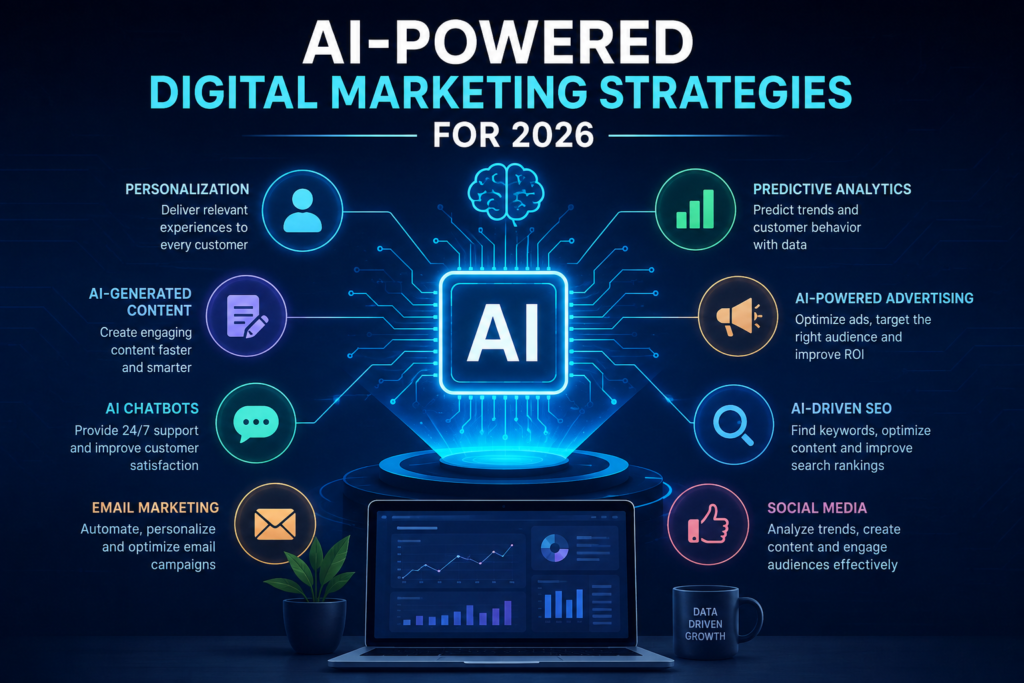
AI-Powered Digital Marketing Strategies for 2026
Artificial Intelligence (AI) is rapidly transforming the digital marketing landscape. In 2026, businesses are moving beyond traditional automation and using AI to understand customers, create personalized experiences, analyze data, and improve marketing performance. From AI-generated content to predictive analytics and intelligent chatbots, AI is becoming an essential part of modern digital marketing strategies.
For businesses that want to remain competitive, adopting AI is no longer simply an advantage—it is becoming a necessity. Here are some of the most effective AI-powered digital marketing strategies for 2026.
1. AI-Powered Personalization
Customers expect brands to understand their interests and provide relevant experiences. AI makes it possible to personalize marketing at a much deeper level.
AI tools can analyze customer behavior, browsing history, purchase patterns, location, and engagement to determine what content or products may interest each individual. Businesses can then provide personalized product recommendations, emails, advertisements, and website experiences.
For example, an e-commerce website can use AI to recommend products based on a customer’s previous purchases and browsing activity. This improves customer experience while increasing the possibility of conversions.
2. AI-Generated Content
Content marketing remains one of the most important digital marketing strategies in 2026. AI is making content creation faster and more efficient.
AI tools can assist marketers in creating blog posts, social media captions, email campaigns, product descriptions, video scripts, and advertising copy. However, successful brands should not depend entirely on AI-generated content. Human creativity, expertise, storytelling, and fact-checking are still essential.
The best approach is to combine AI efficiency with human creativity. AI can handle research, ideas, outlines, and first drafts, while marketers add brand personality, originality, and emotional connection.
3. Predictive Analytics
Traditional marketing often focuses on understanding what happened in the past. AI-powered predictive analytics helps marketers understand what may happen in the future.
By analyzing large amounts of customer and business data, AI can identify patterns and predict customer behavior. Marketers can use these insights to identify potential buyers, predict customer churn, estimate campaign performance, and determine which products are likely to perform well.
This allows businesses to make data-driven decisions instead of relying only on assumptions or intuition.
4. AI-Powered Chatbots and Customer Support
AI chatbots are becoming increasingly sophisticated. In 2026, businesses can use intelligent conversational AI to provide customer support around the clock.
AI chatbots can answer frequently asked questions, recommend products, help customers navigate websites, collect leads, and support purchasing decisions. They can also provide personalized responses based on customer information.
The major benefit is speed. Customers do not always want to wait for a human representative to respond. AI-powered customer service can provide immediate assistance while allowing human employees to focus on more complex customer problems.
5. Voice Search Optimization
Voice search continues to influence how people discover businesses online. Consumers increasingly use smartphones, smart speakers, and other voice-enabled devices to search for information.
AI helps marketers understand conversational search queries and user intent. Instead of focusing only on short keywords, businesses should create content that answers natural-language questions.
For example, instead of targeting only the keyword “digital marketing agency,” a business can create content answering questions such as “What is the best digital marketing strategy for a small business?”
Optimizing content for conversational and question-based searches can help businesses improve their visibility across changing search experiences.
6. AI in Social Media Marketing
Social media marketers can use AI to improve almost every stage of campaign management. AI can help identify trending topics, analyze audience sentiment, suggest content ideas, generate captions, and determine the best times to publish posts.
AI-powered social listening can also help brands understand what customers are saying about their products or services online. Businesses can use these insights to respond quickly to customer feedback and identify emerging trends.
However, brands should maintain an authentic human voice. Social media audiences value genuine conversations, creativity, and relatability.
7. AI-Powered Advertising
Paid advertising is another area where AI is creating significant changes. AI-powered advertising platforms can analyze audience behavior and automatically optimize campaigns based on performance.
AI can help marketers identify high-value audiences, test different advertisements, optimize budgets, and improve targeting. It can also analyze which creative elements generate better engagement.
Instead of manually making every campaign decision, marketers can use AI to continuously analyze performance and recommend or implement improvements.
8. AI-Driven SEO
Search engine optimization is also evolving with AI. Search engines are becoming better at understanding search intent, context, and the quality of content.
In 2026, SEO strategies should focus less on keyword stuffing and more on creating useful, trustworthy, and experience-driven content. AI can help marketers identify keyword opportunities, analyze competitors, discover content gaps, create topic clusters, and monitor search performance.
At the same time, businesses need to focus on expertise, originality, accuracy, and user experience. AI should support SEO strategy rather than replace strategic thinking.
9. Automated Email Marketing
AI is making email marketing more intelligent and personalized. Instead of sending the same email to an entire subscriber list, businesses can use AI to segment audiences based on behavior and interests.
AI can help determine what type of content should be sent to different customers, recommend products, personalize subject lines, and identify suitable sending times.
For example, a customer who repeatedly views a product but does not purchase may receive a personalized follow-up email. This can improve engagement and increase conversion opportunities.
10. AI and Marketing Analytics
Measuring marketing performance is essential for business growth. AI-powered analytics tools can process large amounts of data and provide marketers with meaningful insights.
Instead of looking at dozens of separate metrics, marketers can use AI to identify important patterns and highlight areas that require attention. This makes it easier to understand return on investment (ROI), customer acquisition costs, conversion rates, and campaign performance.
The Future of AI-Powered Digital Marketing
AI is not replacing digital marketers; it is changing the way they work. The marketers who succeed in 2026 will be those who know how to combine AI technology with creativity, strategy, communication, and human understanding.
Businesses should start by identifying repetitive marketing tasks that can be automated. They can then introduce AI into areas such as content creation, customer service, analytics, advertising, and personalization. At the same time, companies must pay attention to data privacy, transparency, accuracy, and responsible AI use.
Conclusion
AI-powered digital marketing is shaping the future of how businesses attract, engage, and retain customers. From personalized campaigns and predictive analytics to intelligent chatbots, AI-generated content, SEO, social media, and automated advertising, the opportunities are extensive.
The goal should not be to use AI simply because it is a trend. Instead, businesses should use AI strategically to understand their customers better, save time, improve marketing performance, and create meaningful experiences.
In 2026, the winning formula for digital marketing is clear: AI-powered technology + human creativity + data-driven strategy = smarter marketing and stronger business growth.